

In the modern industrial landscape, vibration acts as a persistent but often invisible threat to electrical integrity. Heavy machinery, wind turbines, and high-speed rail systems subject electrical connections to constant mechanical stress. Over time, these forces can lead to micro-displacements at the contact point, increasing electrical resistance and eventually causing system failure. Traditional connection methods often struggle to maintain stability under such punishing conditions. Consequently, the role of a China Leading Spring Clamp Terminals Manufacturer has become critical for global infrastructure developers. Specialized manufacturers like UTL Electrical Co., Ltd. address these challenges by replacing static mechanical pressure with dynamic spring tension, ensuring that connections remain secure regardless of external mechanical shocks.
Since its establishment in 1990 in Liushi, the capital of low-voltage electrical appliances in China, UTL has evolved into a global provider of digital electrical infrastructure solutions. The organization maintains a sophisticated industrial chain that integrates R&D, mold manufacturing, injection molding, and production assembly. With 65% of its sales coming from exports, the company aligns its manufacturing precision with international standards. By operating major production bases in Wenzhou, Kunshan, and Chuzhou, and marketing centers in Shanghai and Shenzhen, the company provides the technical expertise necessary to protect critical circuits in the world’s most demanding environments.
The Science of Constant Contact Force
Question: Why is spring clamp technology considered more reliable than traditional screw connections in high-vibration industrial settings?
Reliability in a vibration-prone environment depends on the consistency of the contact force. Traditional screw-type terminal blocks rely on manual torque to create a mechanical bond. However, these connections suffer from a physical phenomenon known as “creep.” Under constant vibration and thermal cycling, the screw may slightly back out, or the conductor material may deform over time. This leads to a gradual decrease in contact pressure, which increases resistance and generates heat. In extreme cases, the connection can loosen entirely, causing an arc or a complete circuit interruption.
In contrast, spring clamp technology, such as that utilized in the JUT3 series, operates on the principle of dynamic compensation. The internal cage spring exerts a constant, predetermined pressure on the conductor. Unlike a screw, the spring possesses elastic memory; if the conductor expands due to heat or shifts due to vibration, the spring automatically adjusts to maintain the same level of pressure. This “automatic tightening” effect removes the risk of human error during installation and eliminates the need for periodic maintenance retightening. For industries like wind power or rail transit, where maintenance access is difficult and vibration is constant, this self-adjusting mechanism provides an essential layer of safety and operational continuity.
Stability and Density in Compact Spaces
Question: How do multi-layer configurations like the JUT15-18×2.5 series maintain connection stability while significantly reducing the physical footprint in control cabinets?
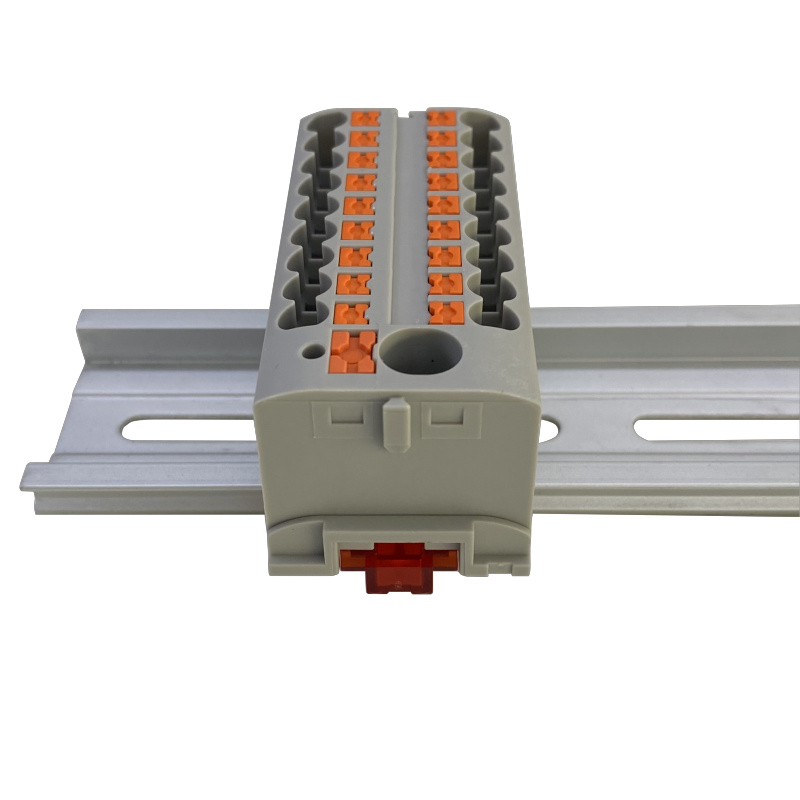
Modern electrical cabinets face the dual challenge of increasing circuit complexity and shrinking physical dimensions. High-density wiring often forces components closer together, which can exacerbate the impact of multi-dimensional vibrations. The JUT15 series addresses this through a modular, multi-layer design that supports numerous connection points within a narrow width. However, maintaining stability in such a compact form requires advanced engineering of both the housing and the internal clamping mechanism.
The JUT15-6/18×2.5-P series utilizes Push-in technology, which further enhances the reliability of high-density installations. Because this technology requires no tools for solid wire insertion, it reduces the mechanical stress placed on the terminal block during the wiring process itself. The internal stainless steel spring in these modules provides high pull-out force resistance, ensuring that even if the cabinet is subject to intense lateral or vertical shocks, the wires remain firmly seated. This combination of space efficiency and mechanical robustness allows engineers to build more capable control systems without compromising on the vibration resistance required for mobile or heavy-industrial applications.
Material Integrity and the Manufacturing Backbone
Question: What role do material selection and full industry chain integration play in extending the service life of spring terminals in harsh environments?
The longevity of a spring clamp terminal is determined by the quality of its components long before it reaches the field. A terminal block is only as good as the fatigue resistance of its spring and the conductivity of its current bar. UTL leverages its full industry chain advantage to oversee the entire material lifecycle. By controlling the mold manufacturing and precision stamping processes internally, the company ensures that every component meets microscopic tolerance standards.
For vibration resistance, the choice of spring steel is paramount. The spring must maintain its tension for decades without becoming brittle or losing its “memory.” The company utilizes high-strength, anti-fatigue spring steel that undergoes rigorous testing to simulate millions of vibration cycles. Simultaneously, the conductive current bars are manufactured from high-grade copper with specialized surface treatments to prevent oxidation and ensure low contact resistance. This vertical integration allows for a level of quality consistency that is often missing in outsourced manufacturing models. When a manufacturer controls the R&D, the chemistry of the plastics, and the metallurgy of the springs, they can guarantee that the final product will survive the environmental aging and mechanical stress of a digital electrical infrastructure network.
Compliance as a Metric for Global Reliability
Beyond the physical hardware, the reliability of a terminal block is validated through international certification. For a non-regional private enterprise focused on the global market, adhering to standards like UL, VDE, TUV, and CE is essential. These certifications serve as independent verification that the spring clamp designs can handle specific voltage, current, and environmental parameters without failure. The ISO9001 quality management system further ensures that the manufacturing processes across all production bases remain uniform and traceable.
The strategic layout of “two points and one vertical” along China’s southeast coast allows the organization to respond quickly to international customer feedback. By listening to the specific challenges faced by users in Europe or the Americas, the R&D centers in Shanghai and Shenzhen can refine manufacturing processes to meet emerging needs. This feedback loop, combined with thirty years of engineering heritage, allows the brand to remain in the first echelon of the global connector industry. As green energy and intelligent manufacturing continue to evolve, the demand for vibration-resistant connectivity will only grow, making the partnership with a deeply integrated manufacturer a vital component of industrial success.
Ensuring Certainty in Unstable Conditions
In conclusion, the necessity of a leading spring clamp manufacturer in vibration-prone environments stems from their ability to provide certainty where there is mechanical instability. Through the scientific application of spring tension in the JUT3 and JUT15 series, the risks of loose connections and electrical failure are effectively mitigated. The transition from screw-based to spring-based systems represents more than just a change in hardware; it represents a commitment to a maintenance-free, high-reliability future for digital infrastructure.
UTL Electrical Co., Ltd. demonstrates that vertical integration—from the initial mold design to the final assembly—is the only way to guarantee the performance levels required by modern industry. As global infrastructure projects become more complex and operate in increasingly harsh environments, the foundational reliability of the terminal block will remain a deciding factor in overall system uptime. By choosing a partner that prioritizes material science and precision manufacturing, enterprises can ensure that their electrical networks remain resilient against the silent threat of vibration.
For more information regarding our vibration-resistant solutions and full product catalog, please visit our official website: https://www.utl-electric.com/.
Post time: Feb-24-2026